
Discover the science behind the golf kinetic chain. Learn how power really moves through your swing, from the ground up, and why sequencing matters more than strength.
Watch a long drive champion swing and you’ll see something strange. They don’t look like they’re trying that hard. The club moves fast. The ball goes far. But the effort looks almost calm.
That’s not an illusion. It’s the kinetic chain at work.
The kinetic chain is one of the most important ideas in golf biomechanics. It explains why some golfers generate huge clubhead speed without brute strength. It also explains why other golfers swing as hard as they can and still lose distance. Here’s the science behind it, broken down in plain terms.
What Is the Kinetic Chain?
The kinetic chain describes how energy moves through connected body segments during a movement. In golf, that movement is the swing. Energy doesn’t start at your hands and travel down. It starts at the ground and travels up.
Think of your body as a series of links: feet, legs, hips, torso, shoulders, arms, hands, and finally the club. Each link can transfer energy to the next one. When that transfer happens in the right order, energy builds as it moves up the chain. By the time it reaches the clubhead, that energy has multiplied far beyond what any single body part could produce alone.
This is the same principle behind a whip crack. The handle moves a short distance, but the tip moves at tremendous speed. The energy doesn’t come from the tip itself. It comes from the transfer of motion along the whip’s length.

The Kinetic Chain Sequence: Ground Up, Not Top Down
A properly sequenced golf swing follows a specific order. Each segment starts its movement, builds speed, then transfers that energy to the next segment before reaching its own peak speed. The sequence looks like this:
1. Lower body initiates. The downswing starts with the feet and legs pushing against the ground. This is often called ground force. The legs and hips begin rotating toward the target before the upper body or arms have done much of anything.
2. Hips lead the rotation. As the lower body drives forward, the hips begin to rotate open toward the target. At this point, the shoulders and arms are still lagging behind, which creates separation between the hips and the upper body.
3. Torso follows. The torso rotates next, catching up to the hips but still trailing slightly. This continued separation is what builds tension and stored energy in the torso muscles, like a stretched rubber band.
4. Arms and hands follow last. The arms and hands are the final link. They release last, after the lower body and torso have already transferred their energy upward. This is why the hands should feel almost passive at the start of the downswing. Their job comes at the end, not the beginning.
5. The club releases at the bottom of the chain. By the time energy reaches the club, it has been amplified by every link before it. The clubhead moves dramatically faster than any single body part moved on its own.
When this sequence breaks down, even slightly, power gets lost. And here’s the part most golfers don’t expect: the most common mistake isn’t a lack of effort. It’s the wrong order.
Why “Swinging Harder” Breaks the Kinetic Chain
Many golfers try to add power by using their arms and upper body more aggressively. This feels intuitive. More effort should mean more speed.
But this approach usually breaks the kinetic chain instead of strengthening it. If the arms and upper body fire early, the lower body never gets the chance to lead. The sequence flips. Instead of energy building progressively from the ground up, it gets used up early, in the wrong link, at the wrong time.
This is sometimes called “casting” or an “early release,” and it’s one of the most common power leaks in amateur golf. The swing looks effortful. It often produces less clubhead speed than a properly sequenced swing that looks much smoother.
This is also why some of the longest hitters in golf, including long drive specialists, don’t always look like the most physically imposing athletes on the range. Their advantage isn’t always raw strength. It’s sequencing efficiency. They waste very little energy along the chain.
The X-Factor: Measuring Separation
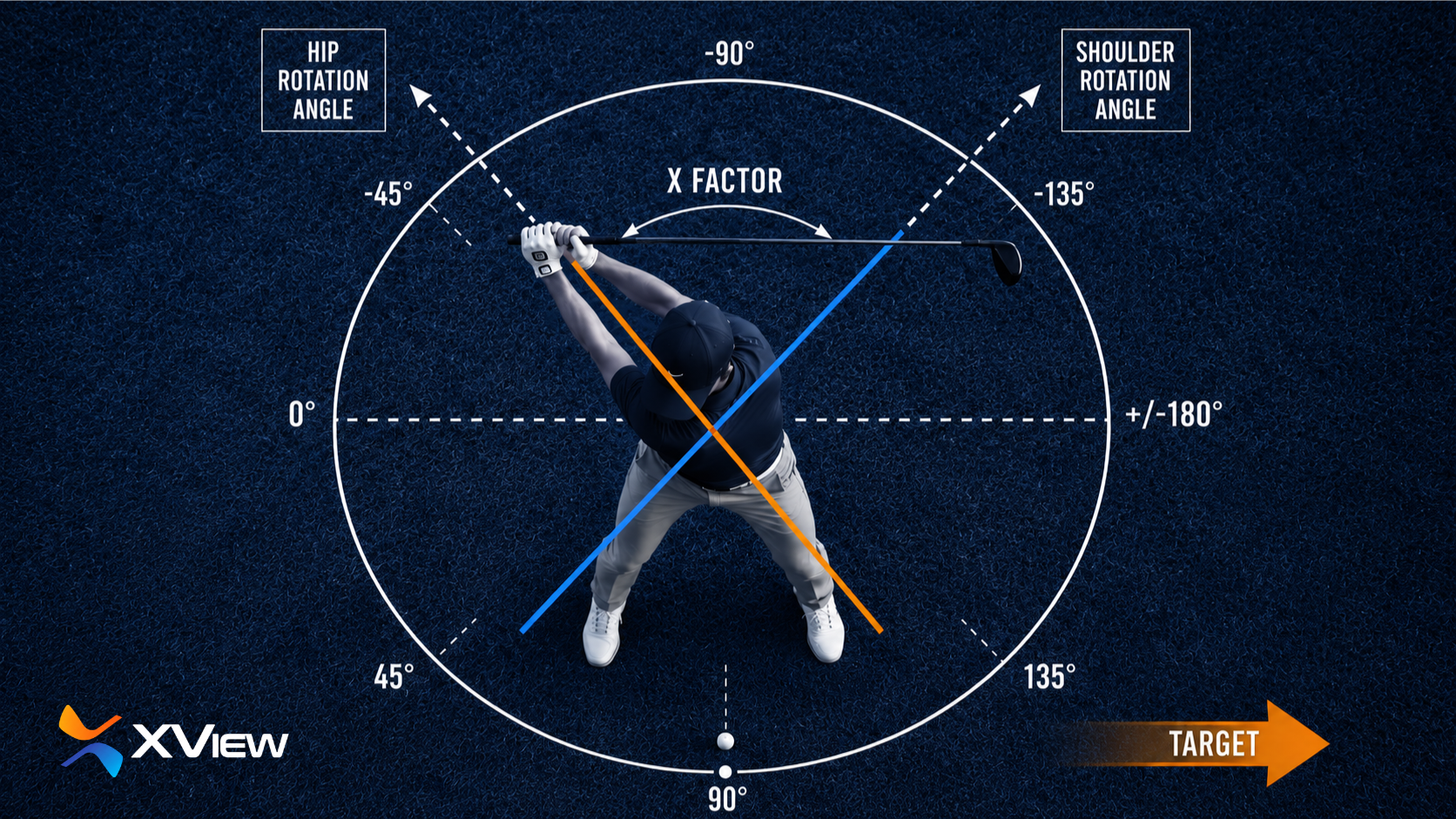
One of the most studied metrics in golf biomechanics is something researchers call the X-Factor. It measures the rotational separation between the hips and the shoulders at the top of the backswing.
A bigger gap between hip rotation and shoulder rotation creates more stretch in the torso muscles. More stretch means more stored elastic energy, which can release into the downswing. This is part of why hip-shoulder separation correlates so strongly with clubhead speed across skilled players.
This is also one of the clearest examples of why biomechanics data matters more than visual inspection. The X-Factor is a rotational measurement. It’s nearly impossible to estimate accurately just by watching a swing with the naked eye. You can sense that someone has “good rotation.” But quantifying it, and tracking whether your own rotation is improving, requires actual movement data.
Why This Is Hard to Feel and Easy to Measure
Here’s the central challenge with the kinetic chain. It happens in under two seconds. The movement is sequential and subtle. Your nervous system simply isn’t built to consciously track the order in which a dozen body segments fire.
This is why so many golfers swing with sequencing flaws for years without realizing it. It doesn’t feel wrong. It often feels powerful, because effort and output get confused with each other.
Biomechanics tracking solves this. It turns the invisible into the visible. Instead of guessing at sequencing based on feel, motion analysis shows the actual order and timing. It captures hip rotation, torso rotation, and arm movement, frame by frame.
Applying the Kinetic Chain With XView AI
XView AI was built around this exact problem. There’s a gap between what a swing feels like and what it actually does. Using markerless motion capture and a Computer Vision Proprietary AI Model trained on millions of golf-specific data points, XView AI tracks full body biomechanics in 2D and 3D. That includes the sequencing data that defines kinetic chain efficiency.
That means golfers and coaches can see hip rotation, shoulder rotation, and weight transfer. They can also see the timing between them, the exact information needed to identify where a kinetic chain is breaking down. Instead of generic advice like “rotate your hips more,” XView AI shows specifically when and how that rotation happens relative to the rest of the swing.
The Takeaway
Power in golf doesn’t come from how hard you swing. It comes from how well energy moves through your body, from the ground, through the hips, through the torso, and finally into the club. Get the sequence right, and speed follows almost automatically. Get it wrong, and no amount of extra effort will make up the difference.
The kinetic chain isn’t something you can fully feel. But it is something you can measure, and once you can see it, you can train it.
See your own kinetic chain in action. Download XView AI free on the App Store.
XView AI is developed by IdeasLab, an AI company building markerless motion capture technology for sports, fitness, and healthcare.